A virtual business address is an address at a commercial mail receiving agency (CMRA), where your mail is held for pickup or remailed to you. You set one up with USPS Form 1583 and two IDs. State filings set their own address rules: Texas, for example, bars a registered office that is solely a mailbox service.
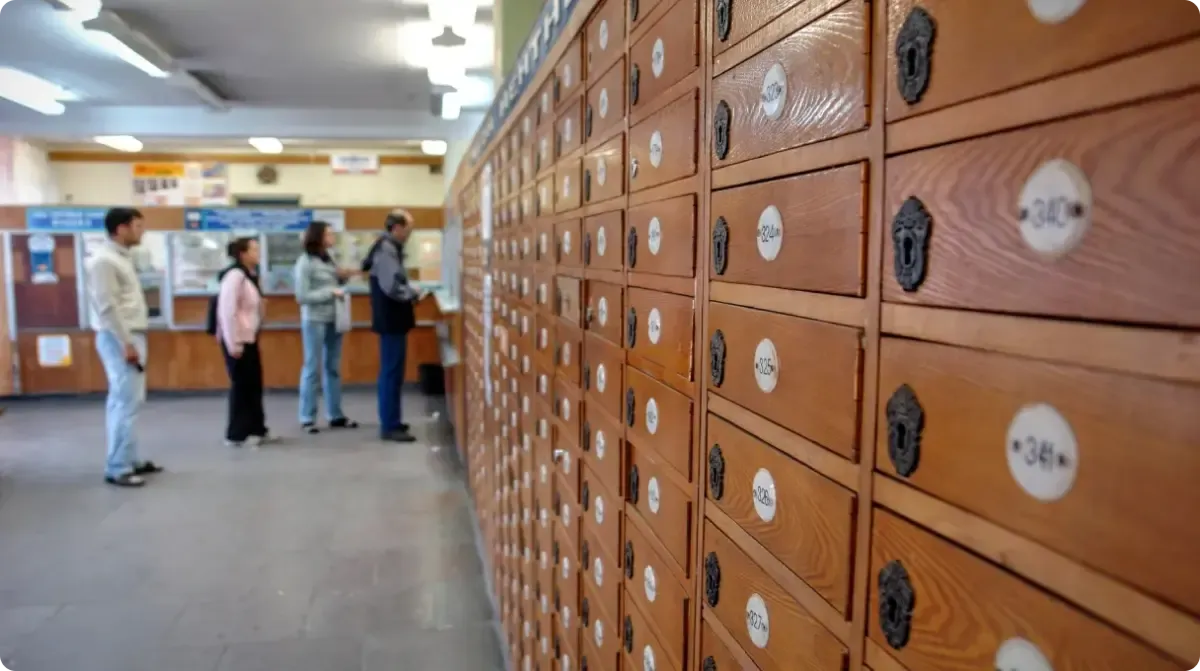
A CMRA is a business that accepts U.S. Mail for others as a business service.
What a virtual business address is and isn't
Under USPS rules, a virtual mailbox at a CMRA is a private mailbox (PMB).
Use the exact mailing format your provider gives you. If the provider’s address already includes a suite number or another secondary address element, USPS requires “PMB” in the three-line format. Keep the provider’s suite number separate from your mailbox number.
Mail forwarding is one of a CMRA's jobs: it can remail your mail to you with new postage. How the options compare:
Option | What it is | What happens to your mail | Rules to know |
|---|---|---|---|
Virtual address or virtual mailbox | A private mailbox at a CMRA, a business that accepts U.S. Mail for others as a business service | Held for pickup, or remailed to you with new postage | PS Form 1583 and two IDs; "PMB" or "#" in the address |
Office business center | A business that mainly provides private offices and business support services | USPS treats it as a CMRA, so the same rules apply | Google: a rented physical mailing address you don't operate from isn't eligible for a Business Profile |
USPS PO Box | A secure, numbered box at the Post Office | Kept there until you collect it | Rented for 3, 6, or 12 months; prices differ by location; apply with 2 IDs at that Post Office |
Registered agent's address | The agent that receives official papers and legal documents for your business, located in the state where you register | Florida and Virginia: the agent forwards process, notices, and demands served on it to the LLC (Virginia: its sole duty) | An LLC, corporation, partnership, or nonprofit corporation needs one before filing (SBA) |
Option
Source: USPS Domestic Mail Manual 508; PS Form 1583; USPS PO Boxes; Google Business Profile guidelines; SBA; Fla. Stat. § 605.0113; Va. Code § 13.1-1015 (checked October 2026).
What founders ask about business addresses
Founders' main question in Bizee support conversations about how business addresses and mail work:
Main question (one per conversation) | Share |
|---|---|
Where a virtual or mailbox address can be used: state filings, the IRS, a bank, an online platform | 23.7% |
What USPS Form 1583 requires (ID, signing, notarization) | 20.2% |
How a virtual address or mail-scanning service works | 18.0% |
About 1 in 14 (7.3%) mixed up a virtual address and a registered agent, or assumed one replaces the other.
Source: Bizee customer-support conversations about business addresses, mail and mailbox ID checks, June 19 – October 27, 2026, classified by AI from the transcripts. Many askers used Bizee's virtual address service, so Form 1583 and mail-handling questions are over-represented. Support contacts are not all Bizee customers, and Bizee customers are not all U.S. businesses.
How to get a virtual business address
You set up a virtual business address by choosing a CMRA and completing USPS's PS Form 1583 with two IDs. USPS's rules set the steps:
- Choose a CMRA. Each one must register with the Post Office responsible for delivery to it.
- Complete every entry on PS Form 1583; the edition current in October 2026 is dated June 2024. For business use, an officer signs with a title, and each person listed to receive mail at the box must show two valid IDs to USPS on request.
- Sign in the physical or live audio-video presence of the CMRA owner, manager, or an authorized employee. Or acknowledge your signature before a notary commissioned in a U.S. state, territory, possession, or D.C., also in person or by live video.
- Show two current, unexpired IDs: a government-issued photo ID and a second that confirms the address on the form.
- Use the box number on your mail: "PMB 234" or "#234," for example. USPS may return mail without it to the sender, marked "Undeliverable as Addressed, Missing PMB or # Sign."
Until the CMRA has your Form 1583 on file, it must return mail addressed to you to the Post Office as undeliverable.
What USPS Form 1583 asks for
ID type | Accepted documents (PS Form 1583, June 2024) |
|---|---|
Photo ID: government-issued | U.S. state, territory, or tribal driver's or non-driver's ID card · Uniformed Service ID · passport (a U.S. passport, U.S. passport card, or foreign passport) · U.S. Access Card · Matricula Consular · U.S. university ID card · NEXUS card · certificate of naturalization · U.S. permanent resident card |
Address ID: confirms the address on the form | Current lease · home or vehicle insurance policy · mortgage or deed of trust · vehicle registration card · voter card · driver's or non-driver's ID card, which counts as only one of your two IDs |
Source: PS Form 1583 (June 2024); USPS Domestic Mail Manual 608.10 (checked October 2026).
The form asks for your street home address, which must match the address document you provide. The CMRA must check your documents to confirm you live or do business at that permanent address, and must deny the application if the form doesn't match your ID. The form warns that giving false or misleading information, or leaving out requested information, may bring criminal and/or civil penalties, including fines and imprisonment.
In Bizee support conversations about USPS Form 1583 and mailbox ID checks, about 2 in 3 (67.3%) involved the ID documents (which IDs count, the second ID or the address on it), and about 1 in 3 (34.7%) a form or ID that had to be corrected or redone.
Source: Bizee support conversations, June 19 – October 27, 2026.
Can you use a virtual address for your LLC?
Yes, you can generally use a virtual address for business mail. Whether you can use it on an LLC filing depends on which address the form asks for. A mailing address, principal office, and registered office serve different purposes. A mailbox with a street address doesn’t automatically qualify for all three.
The Small Business Administration (SBA) says articles of organization describe an LLC's basics. See the steps to form an LLC. It also says an LLC needs a registered agent located in the state where it registers before it files. See what a registered agent does.
We read these seven states' official texts in October 2026. For any state, confirm the current form with its business filing office or a licensed attorney before you file.
State | Registered office and agent | Other address rules |
|---|---|---|
Texas | A street address where process can be personally served on the registered agent during normal business hours; it need not be the principal place of business but may not be solely a mailbox service or telephone answering service | The certificate of formation's initial mailing address, used for the Comptroller's tax mail, may be a post office box or a street address |
Florida | The agent's name, Florida street address, and written acceptance go on the articles; P.O. boxes are not acceptable. An individual agent must live in Florida, and any agent's business address must be identical to the registered office | The articles give the street and mailing addresses of the principal office: the LLC's principal executive office, in Florida or not |
California | An individual who resides in California or a registered 1505 corporate agent; an individual agent's California street address, not a P.O. box, goes on the articles (LLC-1) | The articles ask for the principal office's street address, not a P.O. box, plus a mailing address if different. The Statement of Information (LLC-12) needs a physical principal office address, not a P.O. box or "in care of" address, while its mailing address may be either |
Delaware | A registered office in Delaware, which need not be a place of business, and an agent whose business office is identical with it. The agent may not work solely through a "virtual office" (duties done solely online or solely by other remote communication) or a mail forwarding service, or both | Agent and registered office addresses in filings include the street, number, city, and postal code |
Pennsylvania | The certificate of organization includes the registered office address, "including street and number, if any" | A filing that includes a registered office address may instead use "c/o" plus a commercial registered office provider that has filed (and not withdrawn) a statement of address with the Department of State, and a Pennsylvania county where the office is deemed located for venue and official publication purposes |
South Carolina | An office in South Carolina, which need not be a place of business there, and an agent with a street address for service of process | The articles give the initial designated office's address and the agent's name and street address |
Virginia | A registered office in Virginia, which may be one of the LLC's places of business. The agent is (a) a Virginia resident who is, for example, a member or manager, whose business office is identical with the registered office; (b) an authorized corporation, LLC, or registered LLP whose business office is identical with the registered office, that isn't its own registered agent, and that continuously keeps at that office at least one person it has designated in writing, acknowledged before a notary, to accept service; or (c) a Virginia-resident officer of the LLC (an employee designated in writing, not a member or manager), if the agent or a person the agent designates is available there during regular business hours to accept service | The articles give the principal office's post office address, including street and number if any; it may be the same as the registered office but need not be in Virginia |
State
Source: Texas Secretary of State, Form 205 instructions; Fla. Stat. §§ 605.0102, 605.0201, and 605.0113, and the Florida articles form; California Secretary of State FAQs and Forms LLC-1 and LLC-12; Del. Code tit. 6 § 18-104; 15 Pa.C.S. §§ 8821 and 109; S.C. Code §§ 33-44-108 and 33-44-203; Va. Code §§ 13.1-1011 and 13.1-1015 (checked October 2026).
Using a virtual address with the IRS, banks, and Google
The IRS, banks, and Google each apply their own address rule: Form SS-4's street-address line, for example, can't be a P.O. box. A virtual mailbox may work for IRS correspondence, but having a street address doesn’t make it your business’s physical location. If your business operates somewhere else, use the appropriate physical address where the form asks for it.
The IRS and your EIN application
The IRS asks for two kinds of address on Form SS-4, the application for an employer identification number (EIN). Lines 4a–4b take the mailing address for your correspondence, which the IRS says will generally be used on all tax returns. Lines 5a–5b take your physical street address only if it's different from your mailing address, and it can't be a P.O. box. Line 6 asks for the county and state where your principal business is located: your primary physical location.
See how to apply for an EIN; address changes are covered below.
Banks
When founders asked Bizee support whether a virtual or mailbox address would be accepted somewhere, they asked about a bank most often (38.3%), ahead of the state filing office (18.1%) and the IRS (14.1%). When customers reported that an outside party had refused or questioned their address, it was a bank in about half of those conversations (47.5%).
Source: Bizee support conversations, June 19 – October 27, 2026.
Federal customer-identification rules set the address a bank collects. For a company (a person other than an individual, such as a corporation, partnership, or trust), it's a principal place of business, local office, or other physical location. Each bank's identity-verification procedures must be based on its risk assessment, including its account types, how accounts are opened, the identifying information available, and its size, location, and customer base. So ask your bank which address it accepts before you apply.
See what you need to open a business bank account.
Google Business Profile
Google says a rented physical mailing address your business doesn't operate from (a "virtual office") isn't eligible for a Business Profile. P.O. boxes or mailboxes at remote locations aren't acceptable either. A co-working office can be listed only if it has clear signage, receives customers there during business hours, and is staffed by your own staff during business hours. Service-area businesses can't list a "virtual" office unless it's staffed during business hours, and Google says they should hide their business address from customers.
More on setting up a Google Business Profile.
Keeping your home address off state filings
In the states we checked, the forms decide which addresses go on record: California says an individual agent's name and physical street address are a public record, open to all.
- Texas: the certificate of formation lists the name and address of each initial manager or, with no managers, each initial member
- South Carolina: the articles list each organizer's name and address, and each initial manager's if the LLC is manager-managed
- California: the Statement of Information lists the name and business or residential address of each manager or, with none, each member
- Florida: the articles may list managers' or members' names and addresses, but it's optional
- Delaware: the certificate of formation sets out the LLC's name, the registered office address, and the agent's name and address, plus any other matters the members choose to include
USPS's own rules set when your Form 1583 details can be disclosed. USPS may disclose information to identify an address as a CMRA's address, but that routine use doesn't authorize disclosing the identities of the people the CMRA receives mail for. The form's Privacy Act statement lists limited cases where USPS discloses your information to third parties without your consent. Examples include disclosures incident to legal proceedings involving the Postal Service and for law enforcement purposes. The form makes one exception to all of these disclosures. If you've filed an appropriate protective court order with your application, information about you won't be disclosed except under an order of a court of competent jurisdiction. That disclosure is also subject to the approval of the USPS General Counsel.
USPS's release rule, 39 CFR 265.14, also says Form 1583 information can be released in compliance with a subpoena or court order; if you've filed a protective court order with the postmaster, release requires an order of a court of competent jurisdiction.
Who needs a virtual business address
A virtual address can suit owners keeping business mail away from home, or living or traveling outside the U.S. Among Bizee customers who told support why they wanted a business address separate from home, the most common reason was living outside the U.S. (56.3%). It was followed by keeping a home address off public records (26.6%) and a bank, platform or agency asking for a U.S. street address (15.8%).
Source: Bizee support conversations, June 19 – October 27, 2026.
- Home-based owners: the CMRA receives your mail, but in the states we checked, the forms still decide which addresses go on record. See starting a business from home.
- Owners outside the U.S.: a foreign passport counts as photo ID for Form 1583, and your street home address must match your address document. See running a U.S. business while you travel.
Where a virtual address falls short
A virtual address has limits written into specific rules. Texas bars a registered office that is solely a mailbox service. Delaware's registered agents can't work solely through a mail forwarding service, a "virtual office" (doing their duties solely online or solely by other remote communication) or both. Google says a rented physical mailing address your business doesn't operate from isn't eligible for a Business Profile.
How to choose a virtual address provider
Compare providers on the USPS rules each must follow. First, consider your own address (noting what state filings list) or a USPS PO Box from the table above.
Then ask each provider:
- Is it registered with the Post Office responsible for its delivery? USPS suspends a CMRA that doesn't operate within its rules until it complies. If it doesn't comply in 30 days or less, USPS may end its authorization to accept mail for others.
- Which Form 1583 signing options does it offer: in person, live video, or a U.S. notary? USPS allows each.
- Will your address show "PMB" or "#" with your box number?
- Does it hold mail for pickup, remail it, or both?
- If you cancel, will it remail your mail for at least 6 months, unless you tell it in writing not to?
- Is registered agent service separate from the mailbox?
If you'd like help, Bizee offers virtual address services. It's optional, and the same USPS rules apply whichever provider you choose.
Closing or changing your virtual address
When a mailbox agreement ends, neither you nor the CMRA files a change-of-address order with the Post Office. Instead, the CMRA must remail your mail with new postage for at least 6 months, unless you've given it written instructions not to. A PO Box works differently: once it's closed, USPS tells you to submit a Change of Address form. USPS requires a new application with the CMRA whenever information on your Form 1583 changes.
Businesses with an EIN use Form 8822-B to tell the IRS about a new business mailing address or business location. The form's instructions add that processing generally takes 4–6 weeks.
In Texas, if the registered agent or registered office address changes, the LLC files a statement with the Secretary of State. Texas says failing to maintain a registered agent and registered office may lead to the LLC's involuntary termination. See changing your registered agent or registered office.
A California LLC changes its addresses on record by filing a Statement of Information online at bizfileOnline.sos.ca.gov. See LLC annual reports.
Address rules can change, and they differ between states: compare Texas's mailbox-service bar with Pennsylvania's commercial registered office option. Check your state's current forms, or ask a licensed attorney, before you file or change an address.
Real questions from Bizee customers
Real questions Bizee customers asked our support team from June 19 to October 27, 2026, paraphrased. Answers come from USPS and state sources.
Do I need to do anything before mail can be received at my virtual address?
Yes. USPS requires a completed PS Form 1583. You fill in every entry, sign it in front of the mailbox provider (in person or on live video) or a U.S. notary, and show two IDs. If the provider has no Form 1583 on file for you, it must return your mail to the Post Office as undeliverable.
I live outside the U.S. Which documents can I use for USPS Form 1583?
USPS requires two IDs: a government-issued photo ID and a second one that confirms the address on the form. USPS counts a foreign passport as a passport. Accepted address documents include a current lease, a home or vehicle insurance policy, a mortgage or deed of trust, or a voter card. The home address you enter must match it.
Can I use my registered agent's address as the company's official business address on state filings?
In Virginia, the principal office on the articles may be the same as the registered office and need not be in Virginia. Florida asks for the street and mailing addresses of the principal office: the LLC's principal executive office, in Florida or not. California asks for the principal office's street address and says not to enter a P.O. box.
Bizee is NOT a law firm and does NOT provide legal advice. Use of our products and services is governed by our Terms of Service and Privacy Policy. The information you provide to Bizee is NOT protected by attorney-client privilege.